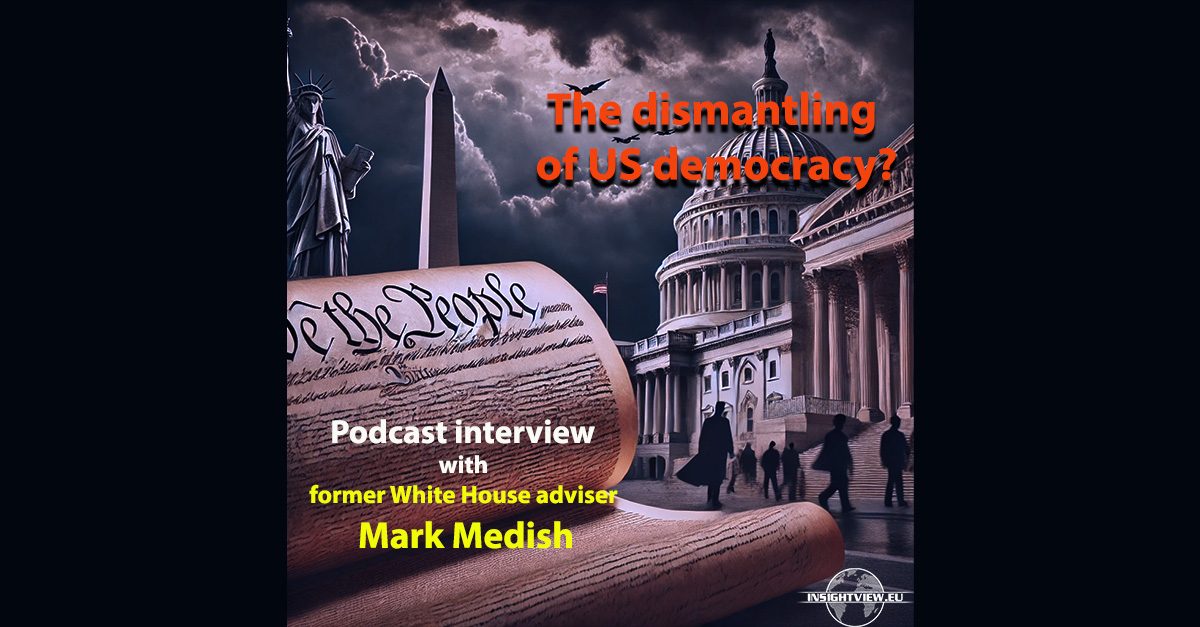
 AI-generated
In this podcast [min. 51 - English], Insightview has talked to Mark Medish, who is an American lawyer and policy consultant with extensive experience in government and international affairs. During the Clinton Administration, he served at the White House as Special Assistant to the President and Senior Director on the National Security Council, as well as Deputy Assistant Secretary for International Affairs at the U.S. Treasury.
" American democracy is no longer merely under threat – the process of dismantling it is well underway,” according to Mark Medish. Insightview is fortunate to have the opportunity to talk to Mark Medish about just how serious the situation has become. Our conversation focuses primarily on the domestic political landscape but concludes with a brief discussion of the geopolitical implications.
[listen to the podcast here on Spreakers]
[listen to the podcast here on Spotify]
[listen to the podcast here on Apple Podcasts]
Mark has also held senior roles at USAID and the United Nations Development Programme. He is currently Director and Vice Chair of Panterra, a strategic consultancy, and founder of Keep Our Republic, a nonprofit organisation dedicated to civic education and democratic governance.
Music: Melodyloops, 'Pure Calmness – by MediaM
See all previous podcasts here: insightview.eu/podcast
Here are 15 bullet points summarising Mark Medish’s main conclusions from the podcast:
*Democracy is more than procedures; it requires a democratic culture grounded in shared values, honesty, and the rule of law.
*The U.S. political system’s structure, with a strong executive and federalism, limits the opposition’s ability to challenge a dominant presidency.
*The Republican Party has been overtaken by the MAGA movement, which operates more as a political cult centred on Trump than as a traditional party.
*Trump’s leadership style is personal, dynastic, and willing to erode democratic norms for power.
*Republican lawmakers’ passivity effectively enables the erosion of democracy.
*Trump’s second term is marked by a “marriage of convenience” between populist MAGA forces and powerful tech oligarchs, despite inherent contradictions.
*The concentration of political and technological power poses a major governance challenge, as legal systems struggle to keep pace with rapid tech developments.
*MAGA’s dominance is not immune to internal fractures, with tensions between its core factions: the MAGA base, tech elites, and the remaining institutional Republicans.
*J.D. Vance is positioned as Trump’s successor, valued for his political adaptability, composure, and communication skills.
*The credibility of U.S. political and economic institutions is deteriorating, undermining public trust and market confidence.
*Trump’s agenda involves radical policy shifts and rule changes that risk creating irreversible damage to democratic structures.
*Economic policies under Trump, including tariffs and protectionism, are regressive, incoherent, and potentially harmful, yet may remain politically viable.
*AI and robotics could reshape manufacturing, but without safeguards, they risk worsening inequality and job losses.
*The U.S. may be entering a “hinge moment” in the global order, moving either toward greater chaos or a reimagined multilateral system.
*America’s domestic trajectory will influence allies and rivals alike, shaping conflicts and cooperation in regions from Europe to Taiwan and beyond.